Guest Blog – NLP – What’s it all about?
Guest Blog – NLP – What’s it all about?

Our brilliant friend and NLP specialist, Victoria Thompson, joined us on a recent Coaching CPD webinar to share her skills and ideas with a community of coaches on all things NLP…
NLP or Neuro Linguistic Programming is such a turn-off of a name, and it puts me in mind of cults and mind control! I wish it was different because I absolutely love the value that the tools that learning and working with it has given me. The problem is, is that it works so powerfully and effectively, and people can choose to use this with strong ethics to make fantastic, positive changes or can use it in other, less positive ways.
You don’t need NLP to coach, and you don’t need to coach to use NLP, but these are two disciplines that enormously complement each other.
Let’s start with what it actually is.
According to the The Association for Neuro Linguistic Programming (ANLP), “A literal translation of the phrase ‘Neuro Linguistic Programming’ is that NLP empowers, enables and teaches us to better understand the way our brain (neuro) processes the words we use (linguistic) and how that can impact on our past, present and future (programming). It gives us strategies for observing human behaviour and learning from the best (and worst) of that!”
Simply put, it’s like learning the language of your own mind and being able to communicate with others more effectively.
Communication is at the heart of coaching so imagine if you could tweak the way you talk to others to amplify those powerful coaching questions, that’s NLP! Imagine if you could reflect back what your client has just told you, in a way that moves them forward from unhelpful ways of thinking, that’s NLP. Imagine if you had a wealth of tools at your disposal that could help the person you were guiding to free themselves of emotional baggage, that’s NLP.
It was difficult to decide on what one thing that I wanted to share with you that I think might add some value to your coaching practice as there are endless options. One technique that just fills me up with positivity is something that stems from the work of Robert Dilts whose model shows that we are made up of several logical levels.
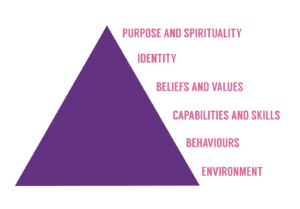
This model is ideal to use for change work, as well as helping someone understanding why they might not be ready to make a change. For change to be effective, it must align at the persons beliefs and values and the identity level.
If I am face to face with a client, I set up the room with each of the levels along the floor so that they can “step into” each level. What I have noticed is a real hesitancy to step into a level where the client doesn’t feel aligned. This speaks volumes and drives a useful conversation
My favourite way to use this model, is to remind someone exactly what their gifts are, and just why they are so amazing at doing that thing they do that makes a difference for others. It’s a way to build confidence and get your client re-enthused about their own amazing gifts. I would love for you to try it. Take some time to imagine doing that thing that makes a difference, that thing you’re amazing at and just write down what comes to mind for each of the areas:
- Environment, where do you do this thing the best? Who is around you, what do you hear them say or see them do?
- Behaviours, what is it about the way that you act that makes you so good at this thing? Are there any behaviours that you do here that you don’t do at other times?
- Capabilities and skills, what capabilities and skills do you have in this area that make the way you do this so amazing?
- Beliefs and values, what is it that you believe about yourself that makes this the right thing for you? How does it line up with your values.
- Identity, who are you, at your core? Why should it be you doing this thing?
- Purpose and spirituality, what ripples does this create throughout the world, how does it contribute to your purpose?
If you have ever done this, you will know it leaves you with a smile on your face. It changes your state into one of positivity and gives you a real confidence boost. It’s also a great way that teams can use to share their strengths with each other. Give it a whirl with a client who is experiencing self-doubt or do it for yourself on a down day. Ask them to remember how they felt when they did this when they are struggling.
If I had to share the biggest change in me since I started my NLP journey, it’s that I’m open to possibilities. I’m open to the possibility that I can do that thing I thought I couldn’t, that things might turn out okay and that the world might just be wonderful. NLP isn’t just any one thing, it’s a combination of many and I think everyone you speak to about this would tell you something slightly different but equally amazing.