Understanding why we get stressed and what we can do about it!
Understanding why we get stressed and what we can do about it!
During Stress Awareness Month our Director of People & Development, Helen Smith, explores stress and the impacts it can have…

April is stress awareness month – and I’m glad it’s a month and not just a day, because let’s face it, stress awareness is a fairly hefty topic! There is lots to explore and learn and then we need time for some reflection if we are going to change the ways in which we are currently impacted by stress.
I thought it would be useful if we started by taking some time to identify what stress actually is and how we can notice it – then later on we can find ways to reduce stress in our lives.
So what actually is stress?
Stress is our body’s defence of flight / fight / freeze mechanisms kicking in to protect us from real or perceived threats. Our body is flooded with stress hormones including adrenaline and cortisol which in small doses can be a useful thing – giving us the boost of chemicals that we need in order to act and keep us safe or to respond on high alert. It can help us focus on a task, make decisions quickly, get ourselves to safely or juggle a moment in life with a bit too much going on! However, when we feel in a permanent state of stress, these hormones will have a detrimental effect on both our physical and mental health and, if left unchecked, will eventually lead us to burnout.
What triggers stress?
We are all different and something that triggers a stress response in one person, another may take in their stride. This is due to our unique genetic make up and unique life experiences that have shaped the way our brains react. However, what we do all have in common is that our stress responses are triggered by something that we perceive as a threat.
These triggers come in many shapes and forms including:
- The way somebody speaks to us – from the words they say through to their wider body language
- Finding ourselves in a new situation
- Feeling overwhelmed with what we need to do
- Relationships – maybe a breakup or losing connection with people
- Life changes – becoming a carer, losing a job, having a baby, moving house
- Money difficulties including debt and ongoing money management
- Health issues – maybe for you or for someone you care about
There are many other things that can trigger a stress response. Some seemingly obvious, others may be more hidden; some that we can quickly reassure ourselves are going to be short-lived, others that we need to find a way to calm the waters as it will be here for the long-haul. The trick here is to be able to identify what our personal stress triggers are so that we can spot them and know that we may respond with our defence responses.
I know that one of my stress response triggers at work is if someone says to me ‘can I have a word?’ as soon as I hear those words, I panic! My heart rate increases, my hands go clammy and all I can think is:
‘What have I done? What did I say? What has happened? Why am I in trouble?’
Now this may seem a rather childish response from someone who is doing ok in their career, however I know exactly where it comes from. Many years ago I had a manager who was not exactly strengths focussed. No matter what the situation, they would start it with ‘can I have a word?’ and then start the conversation with everything that had gone wrong. Praise was sparse and with ‘Responsibility’ as one of my top 5 strengths, I obviously took it all to heart. It has stayed with me, and my stress responses still kick in at this phrase!
So, stress triggers can be big or small, the fact is that no matter what size they seemingly are, they will still put us on hight alert and the more we understand what can trigger that response in ourselves, the more chance we have of managing it.
Did you know, that even thinking about a stressful situation can trigger the same stress response!
Action point: Take time to reflect on your personal stress triggers. When do you notice yourself feeling stressed and what happened to make you feel that way? Maybe try journaling to capture your thoughts.

Stress behaviours:
When our fight or flight responses are activated and our stress hormones are released, it impacts on the way that we behave. It may be that we are just a little irritable or not as patient or smiley as usual. Or it may be that we want to shout or run away! All of these things are quite normal even if it can feel like you’re the only person in the world who responds in that way.
Here is a list that might help you to identify how you respond to stress:
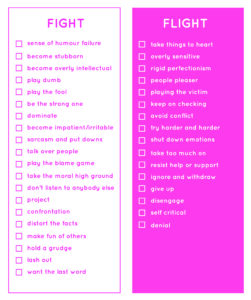
Action point:Take time to notice how your behaviour changed when you felt stressed. What did you do, say, feel or think? Maybe use a journal to capture your thoughts
Spotting the early signs:
Understanding our stress triggers and our stress behaviour is the key to being able to spot stress at an early stage and not let us build up to a point that we are permanently living on our stress defences. This requires us to be honest with ourselves and take some personal reflection time.
It can also be helpful to have a few ideas of what can give us some quick relief from stress. Here are some ideas from us at Team Boo…
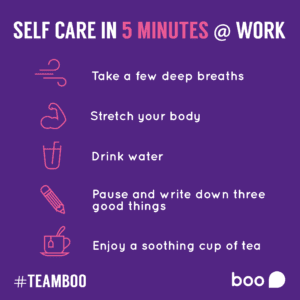
Action point: Take time to reflect on your stress triggers and stress responses. What is one tiny thing you could you do to reduce your stress levels next time you notice these early signs?
Once we understand why our body respond in the way it does, it helps us to prioritise taking time out to reduce our physical stress levels and give out happy hormones a boost! Join us across stress awareness month for some more thoughts on how we can combat stress.
If you want to learn more about how Team Boo can help you create a healthy workplace and reduce stress then take a look at our Wellbeing programmes or talk to Boo! by emailing hello@boo-consulting.com
Take care
Helen & Team Boo xx