Performance does not Equal Happiness
Performance does not Equal Happiness
For International Happiness at Work Week, our Director of Happiness, Amy Rothwell, considers why performing well should never be the only measure of a good organisation.
On the radio recently, I listened to a school defend its extremely authoritarian approach on the basis that it led to better grades. Better grades led to a higher income and therefore a happier life. I don’t want to say too much about it because it got my back up, but my immediate thought was that there were some tenuous claims there.
There may well be proven links between better grades and higher income. The other two arguments compressed around that one bear closer scrutiny. One is that brutal discipline leads to better performance in the long term. The other is that a higher income leads to a happier life.
I’d challenge both of these assertions, on the basis that it’s simply not what we see in workplaces – full of grown-up children who have been through the system and arrived at the ‘goal.’
This school – and its pupils – explained that unquestioning compliance was required, even when the rules felt unfair and didn’t make obvious sense in terms of securing their future wellbeing.
There were punitive consequences for breaking rules: not completing homework to a high enough standard, not labelling clothes properly or forgetting an item, for example. Punishments included teacher aggression, justified on the basis that the teachers “were the adults who knew what was best for the children”.
When authority is synonymous with fear, control and consequences, this may produce results. But at what cost? Sometimes the cost of sacrificing happiness for outcomes.
Of course, no boundaries, no expectations and nobody leading is not a recipe for success or wellbeing either. There must be expectations around behaviour. But can’t these be fair, warm, understandable, inclusive and even shaped by the people expected to live by them?
Take a look at our Boo Behaviours Framework. Each behaviour is linked to one of our organisational values. We take an agreed set of values and work out what needs to happen for us to be at our best for our customers and one another. Each expectation has a purpose that everyone can understand, and everything we ask of people should connect back to that purpose. Here’s the section relating to learning and development, which felt like an apt example.
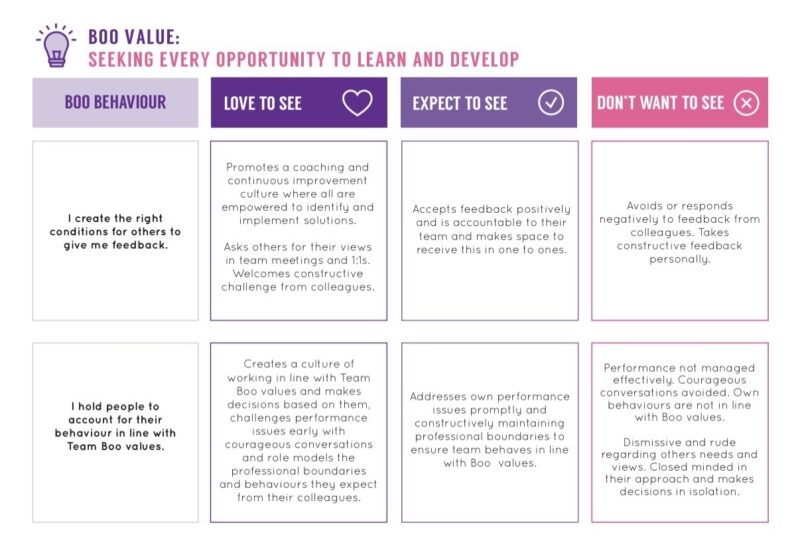
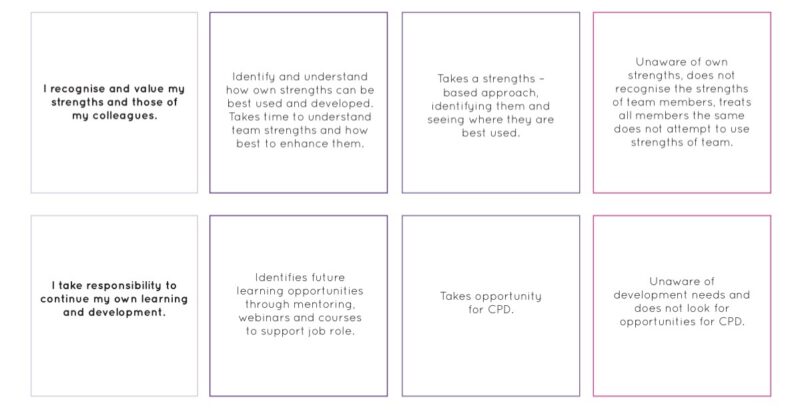
The second argument – that a higher income leads to a happier life – is only partially true.
Money matters a lot when people don’t have enough of it. Beyond financial security, accumulating more wealth starts to bring diminishing returns when it comes to increasing happiness. Research shows that happiness in environments where people are expected to perform well—such as workplaces and schools—is closely connected to autonomy, meaning, purpose, belonging and social relationships.
Over 30 million people have completed the Indeed Work Wellbeing Score . Indeed’s ranking placed belonging and trust above financial compensation as a driver of workplace happiness.
The World Happiness Report found that even after earnings were taken into account, work-life balance, autonomy, variety, job security and support from colleagues remained strongly associated with happiness.
These are not only things that make us happy at work. They are among the things that make life good. They are also things that can be undermined when people use their power over us in an autocratic way.
When measuring the success of any organisation, we shouldn’t conflate performance with happiness. Nor should we focus on attainment as a route to future happiness without considering the multitude of other things that contribute to a happy life.
Employers (and schools) should therefore find ways to nurture meaning, purpose, belonging and positive relationships alongside performance. They should create clear expectations without removing humanity, and boundaries that make people feel safe rather than powerless.
If we try to get the best out of people by insisting on unquestioning compliance, and by making them afraid to get things wrong, they are not thriving.
If performance were all that mattered, nobody would need Boo. But when people can perform well and be happy doing it? That’s when you know you’re onto something.
Amy X
Read next: Work Shouldn’t Drain the Joy from Life