Two overlooked ways in which work can make us happy
Two overlooked ways in which work can make us happy

Amy, our Happiness Ambassador, shares two overlooked ways in which work can make us happy…

Fair pay, flexibility, appreciation and belonging are all important considerations when we are measuring the likelihood of feeling happy in our employment. However, these things relate to the culture and conditions that enable us to work happily and many of them are out of our control. Can work itself and the way we choose to approach it be a source of happiness? Can some of the ‘best moments of our lives’ actually be while we are working? Wouldn’t we still be happier if we didn’t have to work?
I recently had an operation on my leg. On doctors orders I was to do little but relax with my feet up, rest and heal. The first day of this was heavenly. I had snacks, books, peace and quiet. Halfway through the second day, ennui began to set in. By the third day I felt quite depressed. I recall feeling similarly downcast following the birth of my first child; the forced inactivity that I had anticipated with pleasure was not bringing me happiness. I wasn’t sure why.
Like many people, I used to believe that work was a necessary evil – a way in which we must spend the energy of our body and the hours of lives in order to earn our remaining time enjoying leisure.
Yet, faced with the sudden shrinking of my world, without achieving anything I recognise as meaningful with my day, I felt as if I was existing in a listless limbo – waiting to ‘live’ properly again. Is this because my happiness is linked to productivity? And am I just conditioned to feel that way because ‘capitalism’ depends on it? Perhaps, but I don’t believe so.
“Happy people are most likely to feel useful, in control of their life, valued, and satisfied with their mental and material well-being.” -Ipsos Global Happiness Report 2023

Flow
A revelation came five years later, in “All Joy and No Fun: The Paradox of Modern Parenting” (the kind of bedtime reading I consume these days) I read about mothers of young children suffering from a lack of flow in their lives.
“We have all experienced times when, instead of being buffeted by anonymous forces, we do feel in control of our actions, masters of our own fate. On the rare occasions that it happens, we feel a sense of exhilaration, a deep sense of enjoyment that is long cherished and that becomes a landmark in memory for what life should be like.” – Mihaly Csikszentmihalyi – Flow, The Psychology of Happiness
The connection between wellbeing and flow made immediate sense to me. When we are ‘multitasking’, when our attention is divided, when we are experiencing frequent interruptions – all this disrupts rhythmic state of flow that takes some time to get into. When we are stagnant, there’s no chance of flow at all.
I knew that I had experienced feelings of irritation and overwhelm from lack of flow, but I hadn’t given much thought to the positive feelings flow could bring to me. Yet, a runner reading this might recognise the exhilaration of finding themselves in the ‘zone’, when progress becomes almost effortless. Running may bring them suffering in some respects, but the experience of flow is one of the reasons they choose to run again the next day. Psychologist Mihaly Csikszentmihalyi went far enough to assert that the ‘the best moments in our lives’ occur when we are in this state.
“Contrary to what we usually believe, moments like these, the best moments in our lives, are not the passive, receptive, relaxing times – although such experiences can also be enjoyable, if we have worked hard to attain them. The best moments usually occur when a person’s body or mind is stretched to its limits in a voluntary effort to accomplish something difficult or worthwhile.” Mihaly Csikszentmihalyi – Flow, The Psychology of Happiness
Can you think of an example when you have felt this? Maybe whilst exercising, parenting, playing a musical instrument? Have you ever felt like this at work?
Studies have shown that people report more instances of flow whilst they are in work than at leisure – significantly more. The interesting paradox is that they simultaneously report ‘wishing they were doing something else’ other than work, even whilst experiencing that enjoyable state.
This, says Happiness Expert Mo Gawdat, is because of a disconnect between what makes us happy and what we think makes us happy. We do not expect our daily labour to be a great source of happiness in our lives. For Csikszentmihalyi, our jobs should be activities in which we are able to find flow, and if they aren’t, we need to learn to make them that way. If not, we will never be happy at work.
Purpose
Much of the way in which approach happiness is via our consumer consumption habits, whilst ignoring the happiness that comes from ‘meaningful output’. Yet, ‘meaning and purpose’ were listed amongst the strongest drivers for happiness in the Ipsos Global Happiness Report of 2023 . In the Indeed Workplace Happiness Study – the largest of its kind – ‘purpose’ come out as the joint second biggest factor contributing to workplace happiness, ranking far above ‘pay’. This might be surprising to you – it was to me.
I tried to find out why this might be. The results of a 2012 randomised controlled trial “Giving time gives you time” showed that when you give your time to others (for example, in a helping relationship), you feel more ‘time affluent’ than when you a) spend time on yourself b) waste time or c) are given an unexpected windfall of time. Feeling ‘time affluent’ increases your sense of self efficacy and wellbeing. If spending time in a way you perceive to be useful to others increases your chance of happiness, then it does make sense for ‘purpose’ to be such a highly desirable part of employment.
Notice the word ‘perceive.’ Our perception is one thing that is in our control and therefore within our power to change. If you perceive that you are working every day to make your boss rich, this is unlikely to make you feel happy. If you set yourself a goal of simply being the best version of yourself right now in the moment, whatever your current activity, then that becomes your purpose.
This drives you into a space where you are living your purpose and feel meaning. – Mo Gawdat
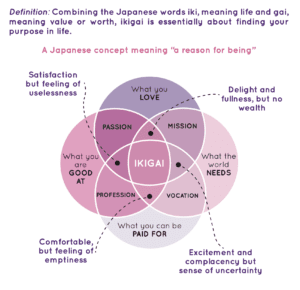
Aristotle made a distinction between types of happiness. Hedonia (e.g., pleasure, enjoyment, comfort) and eudaimonia (e.g., meaning, growth, excellence). Eudaimonia is similar to achieving what the Japanese call ikigai – a state we achieve when we are fulfilling our human purpose. Eudaimonia or ikigai is the type of happiness most likely to be experienced through our employment. If we recognise that we need both purpose and pleasure to thrive, and we must work in order to live, then it makes sense for us to aspire to be happy at work.
Conclusions
Studies show that we are happier when happy at work than when we are doing nothing. Yet, we still don’t believe this to be true. We don’t fully understand what brings us happiness, nor even what happiness fully is. We focus on the happiness that two weeks in the Caribbean can buy us, whilst overlooking the happiness we feel when we are doing something well, with vibrancy and energy, and getting recognition for it.
When we wish away the hours we spend at work, we don’t consider how those hours bring meaning to our lives and positively shape our identity and sense of wellbeing.
According to the Global Happiness Survey, 64% of respondents employed in Great Britain said they were ‘satisfied’ with their work. However, this number has decreased by 11% in the last decade. Yet, 95% of people surveyed believed happiness at work was possible, so there’s scope and hope!
We owe it to ourselves to seek happiness through our employment, just as our employers owe it to their people to create the conditions for them to thrive.
Amy x
We can help you be that employer. Visit out leadership development pages here.
Make your organisation a happier places to work. Visit our workplace wellbeing pages here.