How on earth do we take a proper break?
How on earth do we take a proper break?

Our Organisational Psychologist, Patti Turfrey, share her reflections on how on earth we can get better breaks…
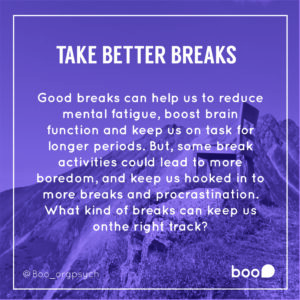
Since the start of the new year, where it has been cold and rainy, I’ve found that my focus has really been affected. I want to take my duvet to bed, create a fort and watch films and hide from the cold! I’ve been really struggling to find and stay in my flow! I’ve once again taken to the research to help myself think about how to get that focus back and wanted to share my findings! One of the things that research kept saying was to take frequent breaks, but I already do that! I work in an environment where we’re encouraged to take time each day to look after ourselves and to rest to be at our best, so what was happening? I came across a really interesting article on my search, that delved into the concept of taking better breaks.
That is when I had that epiphany moment and realised that the breaks I had been taking had inadvertently probably been negatively effecting my focus and also my wellbeing! So, what did I learn about taking better breaks?
Gazzaley & Rosen* have written a book about the types of breaks that can often backfire and cause us to want to take breaks more often…and that’s the trap I was in! Social media/ technology/ the news…they all give us inconsistent feedback and rapid rewards so we crave visiting sites more often, and if we reach for our phones when we start to feel our thoughts distracted from work, the outcome is that we will check our phones more often throughout the day and self-interrupt our work. We may actually be training ourselves to do it repeatedly.
So, in order to get good breaks, they suggest that we avoid our phones or tech and take breaks that engage with the parts of the brain that will serve us most. The pre-frontal cortex (associated with attention, working memory and cognitive resource) is the area that helps us to achieve our goals, so within our break times if we do activities that rely on different brain regions, this will help us to renew focus when we get back to our task.
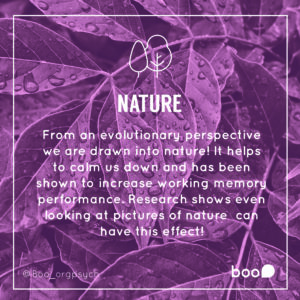
Gazzaley & Rosen report that nature captures our attention because from evolutionary perspective natural stimuli are inherently attractive to us; it draws us in but doesn’t drain on our pre-frontal cortex. Noticing the details of nature can help us recharge: look at plants, bushes, fountains, the colours of nature around you! If you can’t get outdoors, watch videos of nature or even photos of nature for a minute or two.
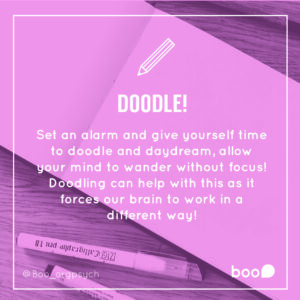 Mind wandering is something that we do a lot less of these days, we fill every moment with productivity or tasks and action points to the point where we have little time to let our mind wander. A wandering mind might provide us with good ideas, reflection and deep thinking. If you find this difficult to do, set an alarm for 5 or 10 minutes, grab a pen and paper and just allow your mind to wander and doodle; it will access different parts of the brain and help to let our mind drift.
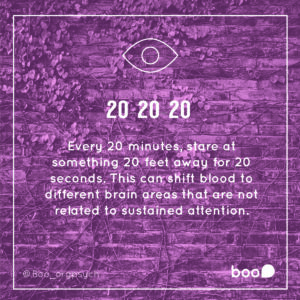
Gazzaley & Rosen also explain that activating brain regions that are not related to sustained attention can shift blood flow and be restorative for our breaks – an easy way to do this is every 20 minutes stare at something 20 feet away, for 20 seconds. This will also help reduce eye strain and fatigue!
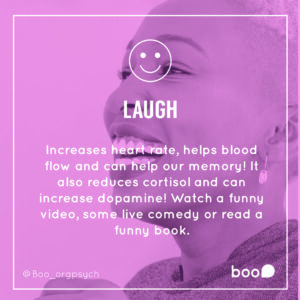
My favourite tool here, is to laugh! Gazzaley & Rosen have demonstrated that after watching funny videos, people scored better on memory tests, had reduced cortisol (the stress hormone) and increased dopamine (the happy hormone). Our bodies also get blood pumping quicker and get ready for moving and action! So, find your favourite thing to make you laugh – a comedy podcast, comics, live comedy, sketches or funny books!
Finally, we all know the benefits to regular exercise – even short bursts of exercise are helpful for our brains – it can aid with attention and also memory! Even a tiny amount of activity- a short walk or a little dance can help to reengage our brain!
I hope you’ve found these tips as useful as I have and hopefully, they can encourage the focus and attention we deserve!
As always, let me know how you’ve got on or if you have any new tips for me!
Love, Patti xx
*Gazzaley, A and Rosen, L (2016) The distracted Mind: Ancient brains in a high tech world