Tips for better sleep – some ideas from Patti
Tips for better sleep – some ideas from Patti


It’s been a tough few years, hasn’t it? The constant worry, changes in restrictions, the uncertainty, the changing work and home demands. It has been a lot!
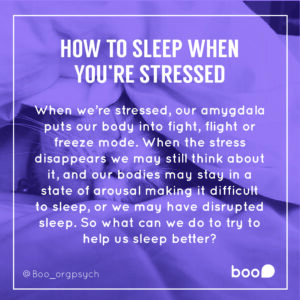
All of this change can lead to overthinking, ruminating, and attempting to plan the unknown; most of which often happens when we place our head on the pillow at night and we get the space to think. Each of these also come with the activation of the fight, flight and freeze response and as a result, our bodies are on high alert, poised and ready for taking action. This is not the ideal space we need to be in for that lovely deep and restorative sleep!
When we do sleep, this is our bodies chance to do miraculous things! When we sleep better, we help to boost our immune system, it can strengthen our heart, it can increase our mood, productivity, and memory.
When working with our lovely customers we hear about so many people struggling with sleep, so we decided to dig into the research to see if there are any lovely ideas of things we can do throughout the day and towards bedtime to increase the likelihood of a good night’s sleep.
One of the things we can start to do, is to think about what is in our control and what isn’t. This might help us to ruminate less on things out of our control. We’ve written a helpful blog about this topic too! It can be found here.
Routine is sleep’s best friend. Consistently doing the same thing before going to sleep will help our brain and body to know and receive cues that it’s time to start preparing for sleep. If you can keep the routine as consistent as possible each day, the brain will recognise the acts as sleep acts. This might be reading, having decaf hot drinks, stretching before lying down, listening to calming music. Anything that you find soothing and starts at least 30 minutes before aiming to sleep.
If you are the type of person that as soon as they get into bed remembers all the things they want or need to do, have a notepad next to your bed and write down everything that comes to mind that you need to do. That way, we can train our brain that it doesn’t need to hold onto that information and keep thinking about it.
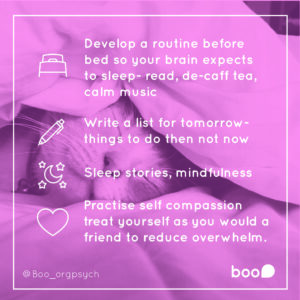
Sleep stories can be wonderful way to help you to focus on a narrative away from the narrative in your mind and help you drift off to sleep. Practising mindfulness before sleep can also be a wonderful way to deal with stress and anxiety, to reduce tension and to relieve muscle tension. There are many guided mindfulness sessions available online, here is a body scan you can use from our Health and Happiness Coach Priya!
One of the other things that often disrupts our sleep is our inner critic; that negative self-talk that we do that often says we should have done things better, we’re not good enough or other harmful things! This often comes up at night as we process the days events. Our inner critic can lead to ruminating and often feeling “stuck” or frozen in a cycle of negative self-talk. One way to try to overcome our inner critic is to practise self-compassion. A really lovely way to do this is to treat yourself as you would a friend. Write down what your inner critic is saying and then underneath this, write down what you would say to a loved one if they were telling you those thoughts. Chances are, you would be compassionate and understanding to your friend. Try to do the same for yourself and write down positive, kind and supportive responses to your inner critic.
The blue light that our phone emits is an artificial colour that mimics daylight. Because of this, it supresses melatonin in our system, which is the hormone responsible for controlling your sleep-wake cycle. Checking our phone also stimulates the brain so we are more active and awake. Try to build an hour of phone free time into your night-time routine to increase melatonin and reduce stimulation.
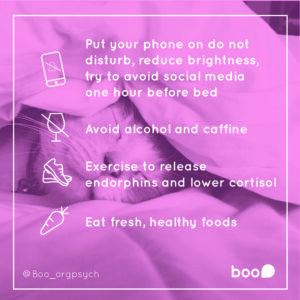
Caffeine’s job is to stimulate us, so naturally, caffeine before bed can keep us awake. Whilst many often think that alcohol helps us to get to sleep, it can actually do the opposite! Whilst it may help us to drift off, alcohol consumption often means that we wake up multiple times in the night and have poor quality sleep. Chamomile tea as part of our night time routine can help us drift off, as well as getting good quality sleep.
Exercise during the day (or at least an hour before bed) can help to release feel good chemicals, reduce the cortisol in our system and help us to better manage our stress and sleep. Do what activity works for you!
Eating heavy, spicy, or fatty foods are harder for the stomach to digest and indigestion can lead to a lack of sleep. Lighter, healthier foods like vegetables and wholegrains are easier to digest and therefore can promote sleep. Bananas contain serotonin; turkey contains tryptophan and berries contain melatonin- all of which are chemicals associated with good sleep. Limiting sugar throughout the day can also help to keep our energy levels consistent which can help to reduce the need for caffeine, naps, or heavy foods which can reduce quality sleep. Staying hydrated throughout the day can also help with sleep as dehydration at night can keep us awake! Do consult your doctor before making any major changes to your diet.
Give these a go and see what works for you! We’d love to know how you get on, so do get it touch with what you’ve tried!
Take care and sleep well!
Patti x